
Meet Leah
I am a scholar-practitioner who has spent more than twenty-five years studying how accomplished adults change, how systems shape identity, and what it takes to navigate pivotal life transitions with integrity.
When I reached midlife, I went looking for a framework that treated it as a developmental threshold rather than a problem to fix. I could not find one. So I built it.
The existing models treated midlife as a problem to solve or a decline to manage. They did not account for the psychological complexity, professional responsibility, and cultural position of Gen X women.
We are not our mothers, and we are not our daughters. Our lives were shaped by a distinct set of expectations, freedoms, and contradictions. Any meaningful framework for midlife must reflect that reality.
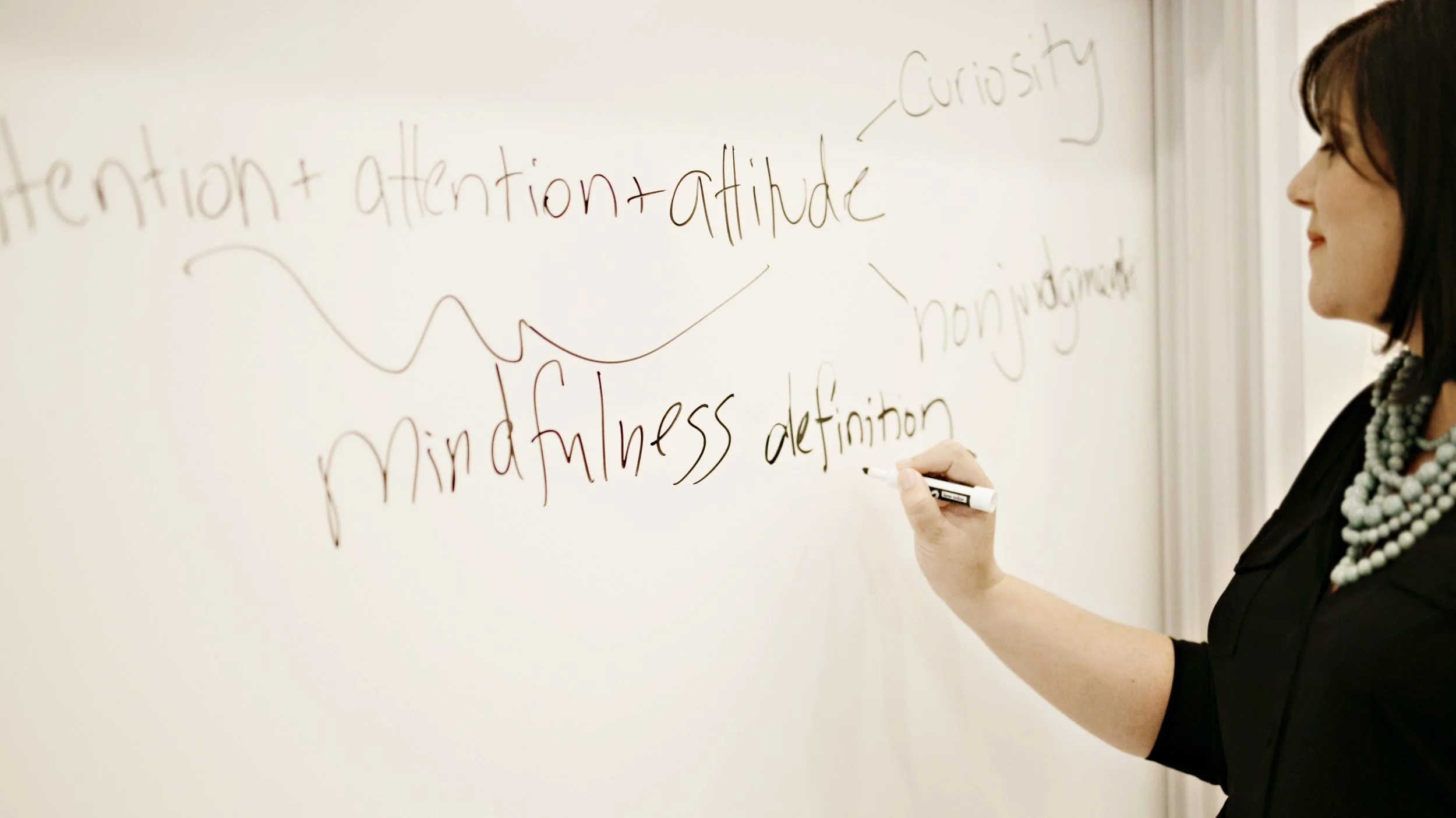
For more than twenty-five years, I have translated complex research into practical frameworks people can actually use. At Stanford, I helped design and scale Compassion Cultivation Training and later taught “Leading with Mindfulness and Compassion” at the Graduate School of Business. My work has consistently lived at the intersection of contemplative practice, clinical psychology, and leadership systems.
Midlife requires the same level of rigor.

The Making of a Scholar-Practitioner
For more than twenty-five years, I have studied compassion, purpose, trauma, resilience, and the conditions that allow human beings to change in durable ways. My work has been shaped by academic study, contemplative discipline, and lived turning points that tested what theory alone could not.
In my twenties, I traveled alone through India and Nepal as a dharma student, studying Tibetan Buddhism and training with teachers while working with Tibetan refugees. I completed extended silent retreats long before mindfulness became an industry. These were not wellness experiments. They were formative.
Academically, I have always bridged disciplines. I studied Tibetan Buddhism and History at Stanford, earned a Masters in Social Work and Pastoral Ministry, and completed a PhD in Theology and Education at Boston College. My work integrated clinical social work, Buddhist practice, and trauma studies at a time when few were bringing those fields together.
Across institutions and sectors, I have consistently worked at the intersection of contemplative practice, psychology, and leadership systems.
Midlife is not separate from this body of work. It is a continuation of it.

My Professional Work and Impact
Over the past two decades, I built my career inside institutions most people only see from the outside: Stanford, Harvard Medical School, the Department of Veterans Affairs, and global corporations.
At Stanford, I partnered with Thupten Jinpa to design and scale Compassion Cultivation Training at the School of Medicine. I later created and led the perennially waitlisted course “Leading with Mindfulness and Compassion” at the Graduate School of Business, teaching MBA students and executives how to bring humanity back into high-performance systems.
In parallel, I worked with clinicians at the Menlo Park VA, helping develop trauma-informed compassion protocols for veterans with PTSD. That work grew out of my doctoral research on compassion and trauma.
My first book, How We Work, became an international bestseller and has been translated into ten languages. My writing has appeared in The New York Times, Harvard Business Review, BBC, TED Ideas, and Psychology Today.
Across these settings, I became known for helping leaders bring purpose, compassion, and structural honesty into systems that were not designed with those values in mind.
Midlife is not a problem to fix. It is a structural transition that requires rigor, honesty, and redesign.

That is only part of the story.
The environments I worked within, including Buddhist communities, corporate mindfulness, and academia, were often shaped by blind spots around power, gender, and integrity. I saw how easily institutions sideline the very people who build them.
Like many Gen X women, I learned what it costs to over-function inside systems that were never designed for us.
At some point, the question shifts from
“How do I succeed here?”
to
“What is this costing me?”
The cost shows up in your body. In your relationships. In your work. In your sense of self.
Midlife is often the moment when that cost becomes impossible to ignore.
This perspective grounds my work today.


The Midlife Curriculum
The Midlife Curriculum is not a self-improvement program.
It is a response.
A response to decades of high functioning without recalibration.
A response to systems that rewarded overextension and called it success.
A response to a generation of women who did everything right and still feel the gap widening.
This work is for accomplished Gen X women who are done pretending midlife is either a decline to manage or a makeover to stage.
Midlife is a threshold.
And thresholds require structure.
At the center of this work is the Midlife Navigation Chart, a six-domain framework that examines the full system of a woman’s life: Physical and Embodiment, Financial and Security, Spiritual and Meaning, Relationships and Connection, Creative and Professional, and Personal Growth and Identity.
We do not isolate problems.
We examine patterns.
We do not chase reinvention.
We design integration.
This curriculum brings together developmental psychology, contemplative practice, trauma-informed therapy, and decades of work inside high-performing institutions.
It is rigorous.
It is grounded.
It is communal.
It is built for women who want to think clearly about their professional lives, their bodies, their relationships, and their time.
Not reactively.
Deliberately.
This is not about burning everything down.
It is about refusing to abandon yourself any longer.
What I Bring to This Work:
• Academic depth without unnecessary complexity
• Spiritual training without bypassing
• Clinical insight without detachment
• Corporate experience without mythology
• A lived story shaped by rupture, rebuilding, and reinvention
• A direct Gen X sensibility that does not tolerate nonsense
I speak plainly about power, pressure, ambition, and exhaustion.
I build structure where there has been fragmentation.
I create containers where honesty is possible.
What I Am Building Now
I am building what many of us never had.
A place where thoughtful, capable women stop performing and start telling the truth.
A place where midlife is treated as a developmental passage, not a personal failure.
A place where clarity is cultivated in community, not manufactured in isolation.
I live in Portland, Oregon, with my family. I write The Midlife Curriculum, maintain a psychotherapy practice with high-performing women in transition, and continue to test and refine this work in real time.
If you are ready to approach midlife with rigor, honesty, and structure, I invite you to begin with The Midlife Reality Check.
Register for the upcoming live 60-minute session.